Thursday, January 7, 2010
Geography and the 19th Century

Geography and the 19th Century
Geography's Affect in the 19th Century
But how does geography fit in with all this? It's quite simple, really. Countries that are right in the thick of things, nations that are neighbors to the new development, gain benefits that others do not. A country that borders a European nation is more likely to trade with them, and therefore gain some of the technology and power associated with the other country. However, a nation that is isolated from Europe, such as Africa, Australia or the Americas, will not have access to the trade and power opportunities. They will then be regarded by the Europeans as barbaric and savage, and the Europeans may feel that it is their duty to civilize them. This could lead the isolated countries vulnerable to conquest and imperial rule by other, more developed countries.
Geography in the 19th Century
Geography and 19th century
In the game of Risk, a game where countries desperately attempt to control various land from numerous continents, includes Nationalism and Imperialism, which turned the tables in the game. Europe in the 19th century needed some way to feel superior and make some type of "progress". To accomplish that they wanted to use imperialism to take over countries filled with "weaker" people. They viewed their own global expansion was inevitable and felt that since they are the superior race, they have a right and duty to "civilize the inferior races". Europe wanted to be superior over the indigenous countries to make the world a better place for Europe and to try to take over more land than other countries. They wanted to progress some way and their method was taking over land masses that were ruled by weaker forces than their own.
Also, the people of Europe wanted to take over Asia and Africa because they thought that the people living there were inferior because of their race. As Europe, and all other land masses, spread out, they divide their forces making each area of land weaker from the lack of forces. I learned this from playing Risk because as our continent took over more countries, we had to occupy each one with at least one army, making each country we already controlled, thinner and not as strong to defend in case the other forces fight back. In the 19th century, Europe took over useless countries just to expand and progress in some manner because after the Industrial Revolution, they felt as if they had unlimited power. They used their racial beliefs and prejudices as motivation to occupy the indigenous continents and to suppress the other people in the world. Overall, the people of Europe used their influence of religion and education to "help" make the world a better place for Europeans and to get rid of the inferior people of the world.
Geography and the 19th Century

The three types of geography, cultural, physical and political, all play a major role in the success and expansion of European nations in the 19th century world.
Physical geography is the obstacles and the resources of the land; both things that the powerful colonizing countries in Europe were concerned with. Europe was not very abundant with natural resources, but many other places, such as India and Africa, were. The physical wealth of the land was what originally drew Europeans to these places. However, the physical geography is also the high mountains and dangerous oceans. In our RISK game, you were not allowed to colonize a nation when you did not share a border. This represents real history because of how much more difficult it was to colonize a nation that was overseas. Obstacles like mountains, seas and oceans made it difficult to colonize because of first, the amount of time it took to get there, and second, the amount of time it took to communicate and connect back with the original conquerors.
This idea leads into political geography. The more spread out a nation is, the harder it is to govern and control because of the lack of communication, and therefore, the lack of a sense of unity. This was reflected in our RISK game, because you lost points if your men were scattered on several continents. Although it makes sense that a nation should want to stay united and keep control of their people, this was not as important to the Europeans. All the Europeans cared about was land, land, and more land. Natural resources in another country might be what made the Europeans want to start colonizing, but competition between other powerful countries was what made them want to continue.
Cultural geography did not so much influence the results of imperialism, but more imperialism influenced cultural geography. As the powerful European nations colonized, they took with them their culture. The picture I posted shows a simple image of what could represent Europe colonizing Africa. They influenced Africa with so much of their culture, they left a huge footprint and moved the cultural geography that original held Africa and Europe separate due to language, religion and tradition.
Wednesday, January 6, 2010
Geography's Significance in the 19th Century
The 19th century was also a time when geography posed less of a challenge to the Europeans with the power of their Industrial Revolution. Steam-driven ships allowed the Europeans to reach far African and Asian ports, and they could also navigate up rivers. The underwater telegraph also helped negate geography because people could send messages over great distances almost instantaneously.
In our game of RISK, Asia proved vulnerable to attack because its vast size allowed Europeans so many different areas it could attack from. Even though in our game the natives joined together to attack Europe, in reality Europe had the advantage. Because it could so easily access Africa and Asia, Europe was able to reap the economic benefits.
Lastly, Europe used the geography of countries like India and China for its benefit. Because most European countries were small they took an interest in the enormous populations that India and China had to offer. In order to sell their goods Europe would export to these countries and take advantage of the huge number of potential buyers in these previously untapped markets.
RISKy Geography
The industrial revolution created a need for raw materials that Europe for the most part could not supply. This was because of the physical geography of Europe, which was not only naturally small, but also not ideal for certain types of agricultural needs. Europe exported the making, mining and farming of raw materials to places better suited for each need, fueling the economy.
Of course, expansion into the lands of other peoples necessitated either a peaceful agreement, or a successful conquering army. As seen in our RISK game, peaceful conquering requires mutual cultural understanding. Because Europe is relatively isolated from the rest of the world by various large bodies of water, a peaceful takeover was much more difficult. This forced EUrope to resort to force, the effectiveness of which was, of course, greatly affected by geography. The farther the trip, the more difficult it is to carry weaponry, as you can only put so much metal and so many people on a ship before it sinks. WHile the Europeans may have developed faster, fancier ships, they still couldn't just hop over oceans, so if reinforcements or supplies of any kind were needed, you had to wait the length of TWO trips across the sea: one to deliver the message, one to actually bring the stuff. And once a land was colonized, it was very separate from its now-leaders, and so more difficult to control, which I think is one of the reasons Europe lost its grip on so many colonies in the 20th century. Nobody likes being colonized, but the Europeans sure liked to colonize others.
Once they started, they couldn't stop. It was the eternal quest for power, and became something just short of an addiction for all Eurpoeans, from the leaders to ordinary "folks back home." But it wasn't only the quest for power: Europe had a stronger need for expansion. As you may have noticed, in terms of land-mass, Europe is pretty small for the amount of countries it contains. As a quote from Strayer says, "If you wish to avoid civil war, then you must become an imperialist." Europe was so small that the issue of where to put everyone began to arise; so naturally the already-colonists turned towards the rest of the world to live in. If Erope hadn't been so small, it is doubtful so many people would have felt the need to leave in order to have the space to do as they needed.
If the world was flat and even, with no real geography, countries would expand the way trees grow: by adding layers at a time. But because of the presence of oceans, mountains, and other such barriers, and the various benefits of certain parts of the globe as opposed to others, the globe was colonized in seemingly random patterns, with colonies from India to the Americas to the Southern tip of Africa. Just as colonialism defines the history of many countries, geography defines the history of colonialism.
The importance of geography in the 19th century
RISKy Geography and the WORLD
Geography's Role in Nationalism and Imperialism
Geography in the 19th Century

A World of Possibility
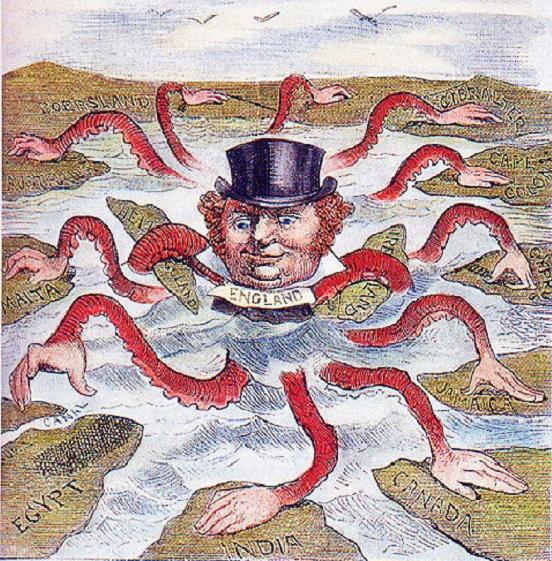 The pressures of a surging imperialism supported by nationalism, pushed Europe to compete for land mass in a world-wide game of RISK. Viewpoints of the time gave the people the indifference to see these lands as mere acquisitions, the political, economical, and human aspects of the issue an afterthought in the face of competition with fellow countries. Like children bickering over who has the bigger pile of rocks, they accumulated the world because of an insatiable need to outdo each other. For this reason, the political geography of the globe became increasingly important to the people of France, Germany, and England (the biggest land collectors). Even without the positive effects of colonization, useless land masses were seen as desirable acquisitions because the people needed to feel that progress was being made somehow, be it through expansion or economy. Ownership over large territories, seemed to them a sensible way to measure power, even if the people of those territories held no loyalties with or pride in the country that had conquered them.
Cultural geography also played a role in inflating Europeans' views of themselves. Though they came into contact with many populous and powerful cultures, difference in religious view allowed Europeans to argue a superiority to these other peoples. Differences too in race and geography were used as further evidence of this belief. In all, geography was what permit Europeans to see themselves as the rightful powers of the world, and have the duty to educate (suppress) the rest of the peoples of earth.
The Importance of Geography in the 19th Century World
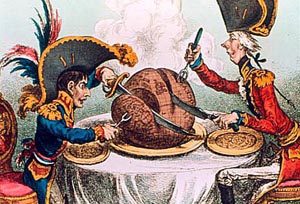
To European countries, geography became the way to judge a country in the 19th century. Not only was physical geography involved, but social and political geography as well.